
Automatic Qualifiers vs At-Large Bids: Who Has the Edge?

If you’ve ever watched the College Football Playoff selection show and felt your stomach twist while waiting for your team’s name to be called, you’re definitely not alone.
One minute you’re confident after a strong season, and the next you’re questioning everything, did we do enough? Shouldn’t we be in already? Why are they choosing them over us?
And that’s exactly where the real debate begins in college football:
Automatic Qualifiers vs At-Large Bids, who actually deserves the edge?
This isn’t just a technical rule discussion. It’s one of the biggest arguments in modern college football. Every season, fans, analysts, and even coaches go head-to-head over how teams should be selected for the playoff.
So, let’s break it down in a simple, conversational way, no complicated jargon, just real football talk.
What Are Automatic Qualifiers?
In the world of college football,CFP Automatic Qualifiers are teams that earn their spot in the playoff by doing one thing:
Winning their conference.
It’s that simple.
If you win your conference championship (or meet the league’s qualification criteria), you automatically secure a spot, no committee debate, no comparison with other teams.
This is where the idea of Automatic Bids vs At-Large College Football becomes important. Automatic qualifiers are based on a clear rule: win and you’re in.
It removes doubt, controversy, and “what if” conversations.
But here’s the catch, it doesn’t always guarantee the strongest teams make it in.
So, then… What Is an At-Large Bid in College Football?
Now let’s talk about the other side.
If someone asks, “What Is an At Large Bid in College Football?”, here’s the simplest answer:
An at-large bid is when a team gets selected for the playoff without winning its conference, based on overall performance.
So instead of a guaranteed entry, these teams are chosen by the selection committee using criteria like:
- Strength of schedule
- Quality wins Overall record
- Head-to-head performance
- Rankings
These are the teams that didn’t automatically qualify, but still look too strong to leave out.
That’s where At Large Bids College Football Playoff conversations get intense. Because this is where debate, opinion, and controversy live.
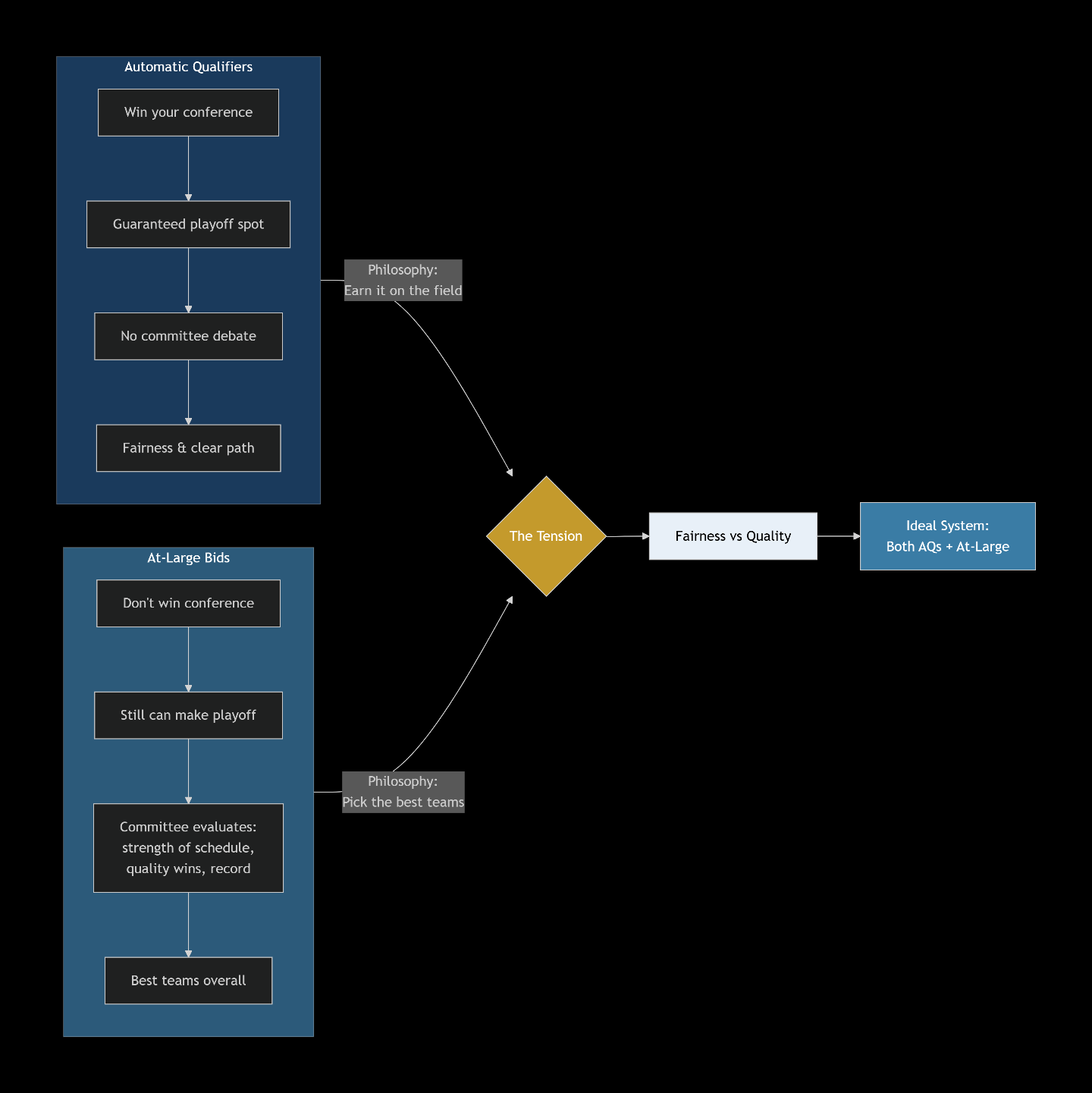
Automatic vs At-Large: Two Completely Different Philosophies
To really understand CFP Qualification Rules, you have to understand the philosophy behind both systems.
Automatic Qualifiers = “Earn it on the field”
This system values:
- Clear structure
- Conference championships
- Fair access for all leagues
If you win your group, you’re rewarded immediately.
At-Large Bids = “Pick the best teams overall”
This system values:
- Overall team strength \Competitive balance
- National performance standards
Even if you didn’t win your conference, you might still be one of the best teams in the country.
So… Who Actually Has the Edge?
Now we get to the real question behind the title:
Automatic Qualifiers Vs at Large Bids, which system is stronger?
Well, it depends on what you value more in college football.
Why Automatic Qualifiers Have an Edge
Supporters of automatic qualification say:
- It rewards winning when it matters most
- Every conference has representation
- It removes committee bias
- It creates clear playoff paths
Think of it like this:
If football is about winning games, then winning your conference should be enough.
There’s also something emotionally satisfying about it. Fans love the idea that their team controls its destiny.
Why At-Large Bids Have an Edge
On the other side, at-large supporters argue:
- Not all conferences are equal in strength
- Some of the best teams might lose a close championship game
- A team with 1 or 2 losses could still be elite
- The playoff should feature the best teams, not just winners
This is especially important in modern college football where schedules vary widely.
A team in a tough conference might be stronger than an undefeated team from a weaker one, but without at-large selection, they’d be left out.
That’s why CFP Automatic Qualifiers alone don’t always tell the full story.
The Real Tension: Fairness vs Quality
Here’s where the debate really gets interesting.
- Automatic qualifiers = fairness and structure
- At-large bids = quality and flexibility
So, the system is constantly balancing two goals:
Reward achievement
Include the best teams
And those two don’t always match.
That’s why every playoff selection season creates arguments across fanbases.
A Real-World Example
Let’s say:
- Team A wins a weaker conference undefeated
- Team B loses 2 games but plays in a brutal conference and beats top-ranked opponents
Who deserves a playoff spot?
Automatic qualification says Team A deserves it.
At-large selection might say Team B is stronger.
This is exactly where At Large Bids College Football Playoff debates heat up every year.
How Selection Committee Fits In
The selection committee plays a huge role in CFP Qualification Rules for at-large teams.
They don’t just look at wins and losses. They analyze:
- Game control
- Injuries
- Strength of schedule
- Rankings consistency
- Performance trends
So, it’s not random, but it is subjective.
That subjectivity is exactly why fans argue so much.
Side-by-Side Comparison Table
| Automatic Qualifiers | At-Large Bids | |
|---|---|---|
| How you get in | Win your conference championship | Selected by committee based on overall performance |
| Certainty | Guaranteed spot – no debate | Not guaranteed – subject to opinion |
| Values most | Conference titles, winning when it matters | Strength of schedule, quality wins, overall resume |
| Best for | Fairness, clear paths, smaller conferences | Elite competition, tough conferences |
| Biggest strength | Removes bias – "earn it on the field" | Includes the best teams regardless of conference |
| Biggest weakness | A weaker conference champ might take a spot from a stronger team | Subjective – leads to arguments and controversy |
| Example | 10–2 team wins its conference final | 11–1 team loses close title game but still ranked top 5 |
So, What’s the Ideal System?
Honestly, most experts believe a combination is best.
- Automatic qualifiers ensure fairness and representation
- At-large bids ensure elite competition
Together, they create a playoff field that is both structured and competitive.
Without automatic qualifiers, smaller conferences might feel excluded.
Without at-large bids, some of the best teams might never get a chance.
Final Thoughts
At the end of the day, the debate between Automatic Qualifiers Vs At Large College Football isn’t about finding a perfect system, it’s about balancing two very different ideas of what “deserving” means in sports.
Do we reward teams for winning their conference?
Or do we reward teams for being the best overall?
The truth is, college football needs both.
Because one brings fairness… and the other brings firepower.
And that’s exactly why this debate isn’t going away anytime soon.
So, the next time you’re watching the playoff selection show, and a controversial team gets in over another, you’ll know exactly why.
It’s not just selection, It’s philosophy.